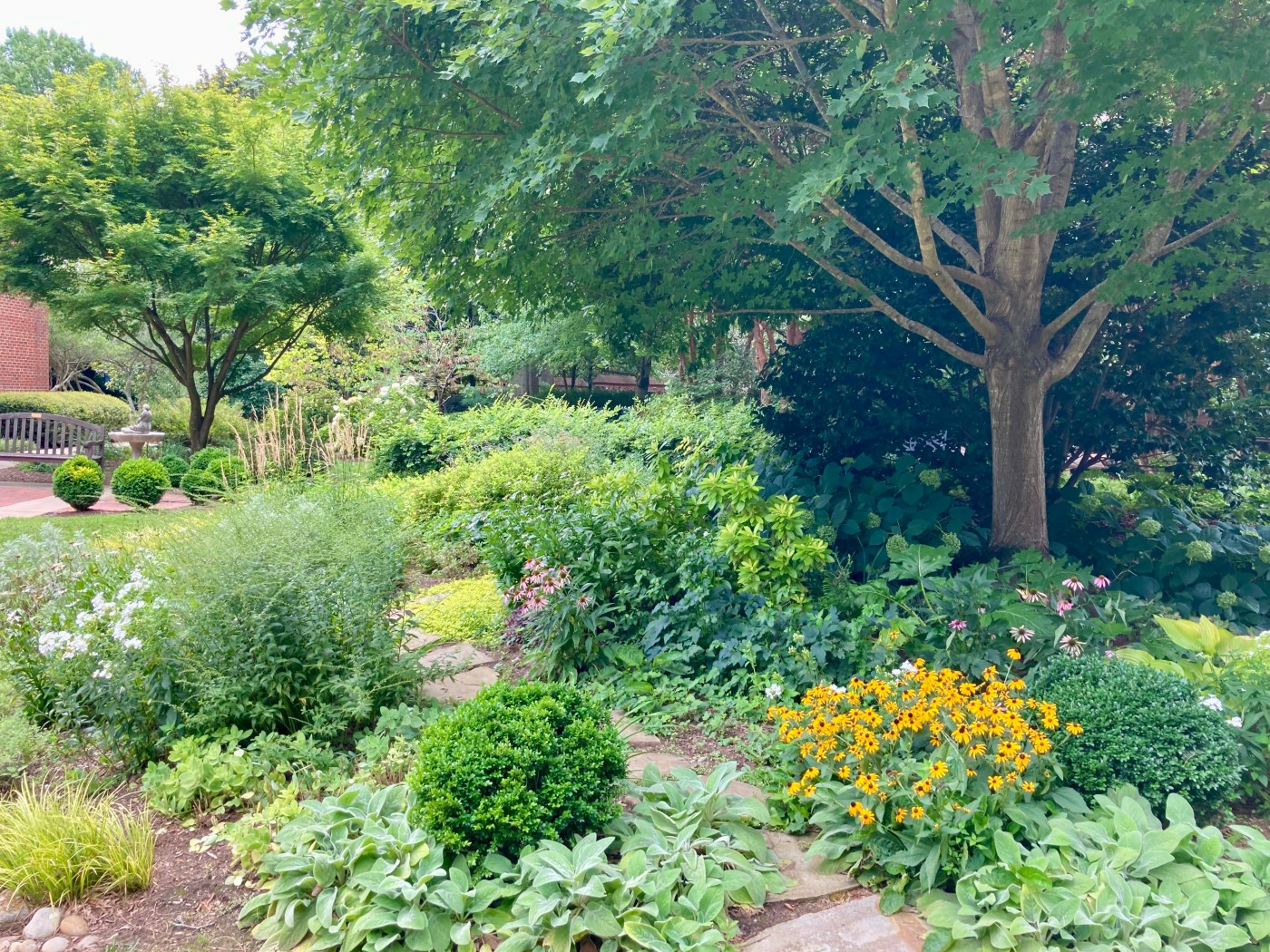
Taking the Introduction to Therapeutic Horticulture course (online) during May-July enabled me to see the “hidden” structures in gardens. Of course, the structure is always in clear view, but I haven’t attended to those details until now.
My interest has landed on restorative gardens, the characteristics in healing gardens and the therapeutic power of beauty. Here’s what holding my attention this month:
Four phases of interaction in nature (addressed in Johan Ottosson’s doctoral thesis, The Importance of Nature in Coping):
- Phase I – Inert objects
- Phase II – Plants and greenery
- Phase I + II – Nature
- Phase III – Animals
- Phase IV – People
Eight characteristics of a restorative garden (Grahn, 1991) (Stigsdotter 2015):
- Serene
- Wild
- Rich in species
- Space
- The common
- The pleasure garden
- Festive
- Culture
Four components of a restorative environment proposed by Attention Restoration Theory (Kaplan and Kaplan):
- Being away/escape
- Extent
- Fascination (soft and hard)
- Compatibility
Four qualities in decoding a landscape:
- Coherence
- Legibility
- Complexity
- Mystery
Stages of involvement according to a person’s mental power (Stigsdotter and Grahn, 2002):
- Outgoing involvement
- Active participation
- Emotional participation
- Directed inward involvement
Spatial definition/three planes of space:
- Horizontal ground plane
- Vertical plane
- Overhead plane
Transitional spaces – spaces that connect one outdoor area to the next.
My continued study in restorative environments and healing gardens is discovery work for a writing project that I label “Story 2.” I plan to circle back on the creative meander on some of the topics noted above. By mentioning them now, it serves as accountability for the future. There are a multitude of opportunities to connect the healing power of nature and our everyday lives. Maybe the list will spark within others an idea or new connection to explore.
“It’s important not to overlook the therapeutic power of beauty. Beauty is a form of emotional nourishment. Research shows how powerfully it activates the emotional centers deep in the brain.” – Sue Stuart Smith, quoted in the article “Why Gardening Offers a ‘Psychological Lifeline’ in Times of Crisis.”
 creative meander
Leave a comment