“The perfection is in the repetition, the sheer ordinariness, the intimate familiarity of a place known because we have visited it again and again in so many different moments.”
As I reread the words by Wayne Muller on April 8 while under a Staying at Home order, I recognized the intimate familiarity of “a place known,” was the unknown. I have spent a lot time writing about the unknown, but rarely valued its true worth. Throughout life, it served as a catalyst. I always wanted to know, to find the answer and take a step into knowing. Time spent not knowing was viewed as wasted time. The receptivity of “the gift of time” during March enabled me to recognize the Not Knowing Place. And as Muller suggested, I have visited it again and again in so many different moments. Through all the seasons, through all the years, through all the days, and even in the moments, I have found myself in the Not Knowing Place. I actually “knew” this place!
When I finally accepted this paradox, the unknown was a place known, I labeled it the Not Knowing Place. By releasing my worn-out conditioning, and paying attention to what I already knew about the Not Knowing Place, I realized that encountering Not Knowing (the unknown) does not automatically equal any sense of failure. This is the liminal space of change, transition and growth. (In May I would learn more about this.)
Turns out a lot of people knew about the Not Knowing Place and had written about it. Once I recognized “the intimate familiarity of a place known” was the Not Knowng Place, I began to find guides who had already explored Not Knowing.
From “Seven Thousand Ways to Listen” by Mark Nepo, page 104:
To bring trust back to life requires the deepest sort of listening. I’m still learning how to listen in this way. Even after sixty years, it feels elusive, as the most important teachers whisper behind the wind to ensure that we give ourselves totally to discovering their secrets. Two such teachers are not-knowing and paradox. Essentially, I have learned true knowledge that can help us live waits on the other side of our ability to hold two things at once that are both true. One aspect of true knowledge that came to me through my experience with cancer is the paradox that we need to die in order to live. I am still trying to understand the daily meaning of this…
Page 106:
It seems that the practice of not-knowing begins with a trust in the unnamable space that holds us in the mysterious atmosphere in which we all live. That seems to be the true space of listening and learning, where our brief experiences of life in its totality, whether harsh or calm, will not fit into our tidy little map of perception. Until I had cancer, until I found myself close to death, I had, in very typical fashion, thought of life and death as two different continents, one leading to the other. But almost dying thrust me below these distinctions, below the map of names. And in that tide of pure, unnamable experience, life and death pooled together; indistinguishable, one informing the other. Being spit back into the days like Jonah from the mouth of the whale, how can I return to the map I was given that presumed they are different?
“After all this way, I can only affirm that this trust in not-knowing has always been essential. Yet where are we educated in this? Where are we taught to withstand the surf and undertow of ambiguity and confusion long enough till we can drift into the majestic swell that sages and poets of all traditions have called the unity of life?”
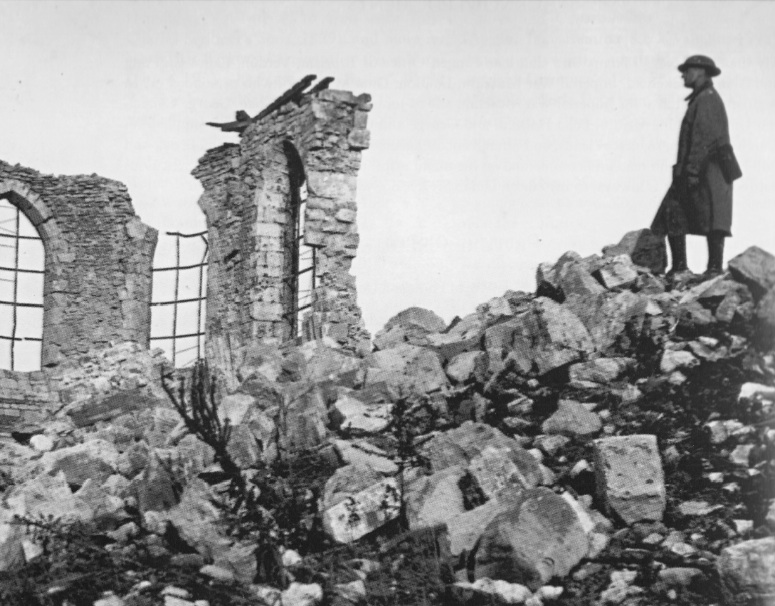
I found Mark Nepo’s excerpts in a journal entry from January 3, 2015 (so the not-knowing was in my realm of awareness, but not embraced) and noted, “As I transcribed the words from Nepo’s book, the WWI soldier standing amidst the ruins of Montfaucon returned. There is a point in time when we all must realize the map that served us well in the first part of life no longer works. We find ourselves on new ground and become the pioneers of our own lives.”
 creative meander
Leave a comment