May 2: (1 of 3): I headed to the Hostellerie Coq Hardi. Since Coq is rooster in French, it wasn’t surprising to find roosters the theme in the lobby.
The floorboards creaked as I entered my room. The curtains were drawn, so I switched on the overhead light. A fabric of harvest gold roses, not wallpaper, covered the walls. The unattractive fabric walls and matching harvest gold drapes made the room extremely dark. I opened the curtains to a view of the post office across the street.
There was no time to be concerned with the décor of my room since the clock was approaching 2 o’clock. I tossed my luggage into the room and headed outside. I found the Tourism Office. It was a dismal place. I saw people boarding a mini-van across the street. I looked at the sign: Champ de Bataille leaving at 2 o’clock.
“Is there room for one more person on the tour?”
The hostess replied, “Yes, but it’s a French/German tour. The guide won’t speak any English.”
“That’s okay, I’d like to take the tour.”
Another hostess darted across the street to alert the tour guide of an additional person joining the group. After paying my fare, I ran across the street.
The tour guide asked in French, “Do you speak French?”
I replied, “No.”
She asked, “Do you speak German?”
I replied, “No.” (I didn’t mention I had three years of German in college.)
“I speak very little English,” she said.
“That’s fine. I want to see the sites.”
I boarded the mini-van and sat down in the only available seat – a folding jump seat in the aisle. The man sitting next to me turned to me and said, “I speak English! I will translate for you!”
So, the tour guide would speak in French, then in German, and the kind Belgian man would translate into English. As the mini-van headed out of the Verdun city limits, the driver made a quick stop in front of a cemetery. He drove across the lane of oncoming traffic, then over the curb, and stopped the van on the sidewalk. (I began to wonder what kind of ride this was going to be.) The windows were fogging up on the inside, so with my closed umbrella I wiped away the condensation to get a better view of what was outside.
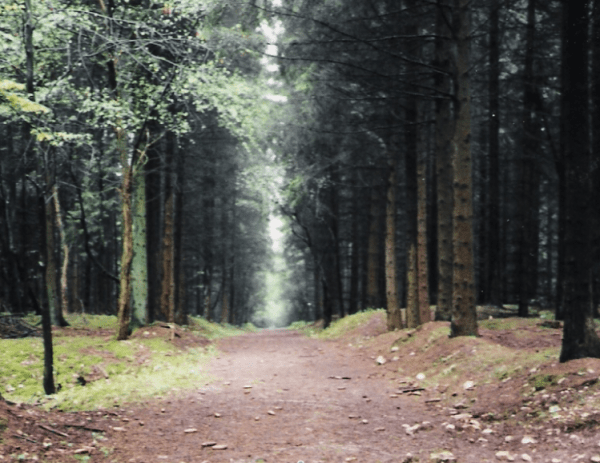
As we drove toward Fort Vaux, there was a transformation in the landscape. The trees became stunted and the ground pocked with craters. There was a sign of a lighted match inside a red circle with a cross mark that served as a warning. No fire. There were still live bombs in the woods. So many thousands of shells dropped into the ground that the buried ammunition of decades past could still be sparked by a match.
No Man’s Land – Fort Vaux
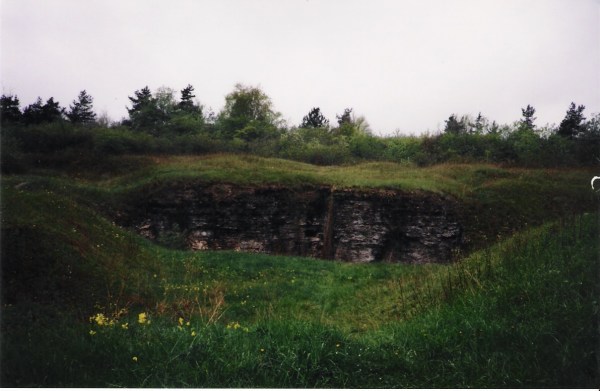
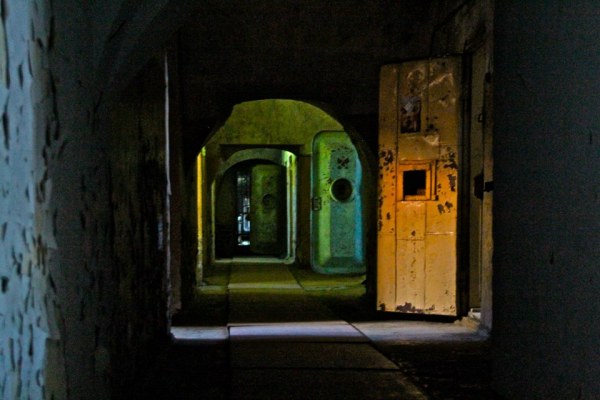
Fort Vaux was built into a rock formation. It was starting to rain as we headed into the visitor’s entrance. The tour guide picked up an English handout from the visitor’s desk and gave it to me. The fort smelled musty from the dampness, and it was chilly. I met the Belgian man’s wife. She spoke English too. We headed into a dark exhibit area that held a few personal effects from the soldiers, and then walked into the main corridor of the fort that was illuminated by bare light bulbs spaced far apart. The rooms off the main corridor dropped into blackness. Some rooms had numbers corresponding with numbers on my handout sheet. We walked down the corridor to the right and viewed the hospital rooms, barracks filled with bunks, stairs leading down into a black abyss, and an escape tunnel. Puddles of water stood in the floor. The Belgian woman and I discussed what it must have been like for the soldiers trying to survive here in the winter. I expected to see a rat sneaking down the dark, dank corridor.
There were many openings off the main corridor. A short distance from one opening was a large mound of dirt that was topped by a Latin cross, which was illuminated by a light bulb. It was a mass grave that ran parallel to the corridor we were walking through. As we continued to walk to the other end of the fort, we passed a chapel. I read my handout. During the war, the dead bodies were placed in this area and covered with lime.
Later, the area was bricked up. The bodies remain behind the wall. The area in front of the wall was transformed into a chapel. A few candles were burning. I lit a candle for the unknown French soldiers and said a prayer of remembrance for them.
The tour congregated in the gun room where the rusty gun remained. The large barrel stuck out through a hole in the fort’s wall. I looked out another opening and saw a choppy, turbulent sea of earth under thick hovering gray fog. Each hillock was created by bombs. I’ve always heard of “no man’s land,” and here it was. Time stood still. It was untouchable, and desolate. The land was lifeless, and nothing moved but the fog. The tour moved on and took us all away from the lookout across the war zone.
We returned to the visitor’s center at Fort Vaux. I bought postcards of WWI soldiers at the Ossuary on Remembrance Day. Before returning to the bus, I walked to the edge of the parking lot and took a picture of the landscape. I was amazed that no one else seemed to pay attention to the land surrounding us. The land had been free from war since 1919 yet the effects of the war continued to haunt it. The parking lot was the only leveled ground in sight. Deep bomb craters were everywhere, and they were staggering. The trees were small saplings; the trunks were no larger than a woman’s wrist. I thought of the trees back home that were over fifty years old: The oaks, elms and maples towered above the streets and their branches reached out like a grandmother’s open arms.
Pigeon Rings
The next stop on the tour was the Memorial of Verdun that displayed relics from both the French and German sides. There were hats, uniforms, ammunition, guns, documents, and pictures. We were herded into the auditorium to watch a film, In the Soldiers Footsteps. I received a headset that translated the audio into English. A blur of faces and troops is what I can remember most, not the words. Although I do remember a statement,
“These soldiers were men with a different character; strong men who walked into a battle knowing they would die.” They knew they would die. This was the truth of their war.
I was intrigued by the display in the center of the memorial of razed earth as it might have been in 1916 – cratered and scattered with the remains of war and void of the presence of life. I tried to visualize the entire region of Verdun as depicted here. I discussed this scene with the Belgian couple, and then the Belgian man told me the story of his grandfather who was killed by the SS (Schutzstaffel) during WWII.
His mother was 14 the day she opened the door to discover the SS or “Nacht-und nebelgefangenen” (Soldiers of the night and fog) on their porch. Along with being a doctor and a mayor, his grandfather made pigeon rings that were attached to a carrier pigeon’s leg. Carrier pigeons were an important method of communication in WWII. The Nazis wanted to kill all the French pigeons to help stop French communication.
The SS had issued the command for the French to bring either the pigeon or the ring to them. (When they had the ring from the pigeon’s leg, they knew the pigeon was dead.) A member of the resistance had asked the doctor to help him make an extra ring for his carrier pigeon. Then he could give the Nazis the fake ring and would still have his pigeon to send messages. The doctor said he would do this but asked him not to tell anyone. The Belgian man added, “I’m not sure how many rings my grandfather made for the resistance, but this is why the SS took him away.”
When the SS took the doctor to prison, his wife was pregnant with their fifth child. The doctor was killed in 1944 and never saw his son. Fifty years later, in 1994, the Germans wanted to reconcile and the Belgian man and his family went to the prison. His grandmother and uncle (the son who never saw his father) did not. She never remarried, and her life changed dramatically from being the wife of a doctor and mayor to being a widow with five children. The Germans returned letters that his grandfather wrote in prison but were never mailed by the SS. In the letters, the doctor spoke about the child his wife was carrying.
Continue reading “Joining the ‘Champ de Bataille’ “ →
 creative meander