Returning to the heart with peace

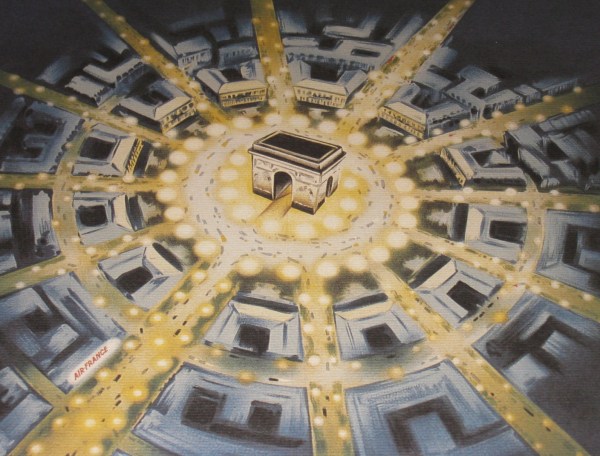
May 5: The next morning in Paris, I walked over to the Arc de Triomphe. Once again, I stood at the foot of the tomb of the Unknown Soldier, my eyes transfixed on the eternal flame. I believed a revelation would occur. Nothing external happened. But suddenly I realized the revelation was within me.

Peace begins with me.

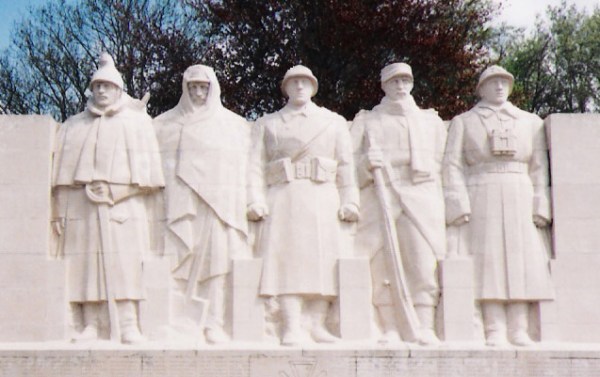
The Unknown Soldier buried beneath the massive monument was a man with a body who fought in Verdun. It’s so hard to remember that fact when you’re faced with the massive surfaces of stone, marble and brass. He had a life, he was part of a family, and he had a heart. In Verdun, the soldiers died. Most walked into the battle knowing they would die. They died fighting in a war that was to end all wars. And yet, the world continues to war on the outside.

For me, there was an echo that I now understood: 

Remember them. Remember the gift they gave you. The peace begins within you.

Continue reading “Returning to the heart with peace”

The visit and return to Paris

May 4: I had been in Verdun where hundreds of thousands of soldiers were killed due to war.  I had spent two intensive days searching for the unknown soldiers and found myself acknowledging the impact of war’s devastation and death. I had walked where life had been extinguished over and over again. I had drifted into the underworld. If there were ghosts, or souls doomed to walk through battlegrounds because their bodies lacked a proper burial, or unsettled spirits caught between realms of life and death, my guess was that they would be here in Verdun. 

I awoke at 5 o’clock to the creaking of hardwood floors. It was a consistent creak and sounded like someone was standing on my floor, watching me. I opened my eyes and saw nothing but darkness. I listened intently to the creak. It was coming from the floor, or near the chair, by the windows in my hotel room. It was unsettling because I knew the noise wasn’t coming from the room above. On Saturday night, I heard the sound of people walking on that floor. This was a different creak. It was coming from my room and sounded like someone was shifting weight from one foot to the other foot. There was a presence in my room that wasn’t me. 

Continue reading “The visit and return to Paris”

Entering Cote 304

May 3: Finding my way to Cote 304

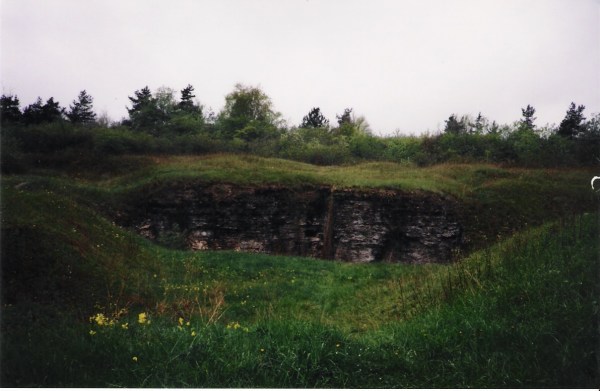
I could see the approach of Cote 304 because a grove of Australian pines was nearing. The worst areas devastated by the war were reforested in the 1930s with Australian pines. It would take over three to four centuries for nature to fully recover the area. That evidence was clear wherever I went from Fort Vaux to Le Mort Homme where the artillery had broken the ground and shattered the subsoil.

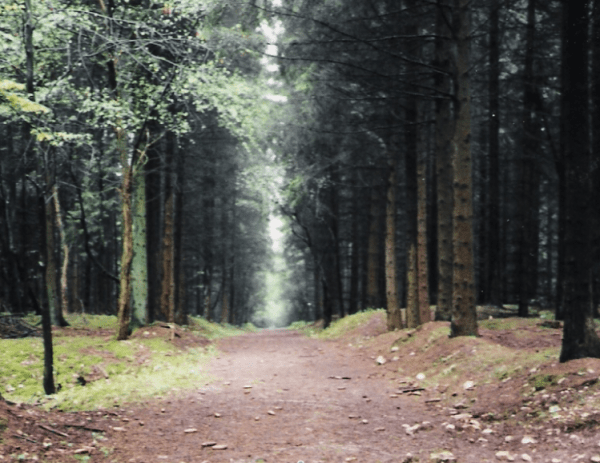
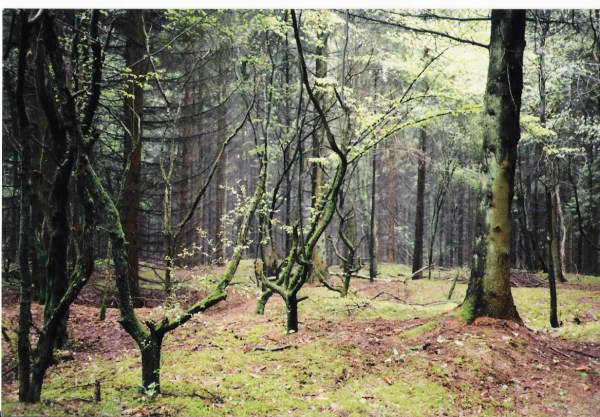
The car turned onto a narrow lane that meandered through a forest of green conifers, which held back the sun and cast darkness onto the wood line floor. We approached the summit and circled around a tall monolith memorial. Marc and I got out of the car and I walked over to the woods at Cote 304. The ground was pocked and cratered by the bombs and ammunition that had blasted devastation into the ground. There was a dirt road cutting into the wood line. The stronger voice inside me whispered, “Go there.” I walked into the wood line aware of the magnitude of death that saturated the soil, knowing each step I took at Cote 304 was on the battleground where the living had fallen dead.

I stood there, feeling like a living sacrifice, with my hand up near my face. I could feel my breath on my hand. I could feel my face against my hand. I needed this sensory connection to life. As I stood there, the wind whispered through the pines. My eyes noticed the ground was blanketed in pine needles. Green moss grew in patches. Weeds grew in other places. There was life on the wood line floor. Although it looked dark from the road, I realized there were shafts of light streaming in the wood line. The wood line wasn’t filled with death. I stood on the ground of Cote 304. I wanted to remember and feared that my memory would forget. I took two pictures, and then regretted the noise from the shutter clicks. The woods deserved silence. I decided not to make any more noise on the ground where so many thousands of soldiers had died.

Continue reading “Entering Cote 304”

Entering the darkness at Fort Douaumont

May 2 (2 of 3): It was still raining as we departed the van. The parking lot of Fort Douaumont was a white muddy field. Barbed wire encircled the fort’s perimeter, and green grass covered the surrounding craters. There was a winding path leading up to the top of Fort Douaumont, but we headed down into the entrance door and visitor’s center. My first impression after crossing the fort’s threshold was the stench. It smelled like a rotten Pont l’Eveque cheese. (Pont l’Eveque is a pungent cheese when it’s fresh.)

Continue reading “Entering the darkness at Fort Douaumont”

Joining the ‘Champ de Bataille’ 

May 2: (1 of 3): I headed to the Hostellerie Coq Hardi. Since Coq is rooster in French, it wasn’t surprising to find roosters the theme in the lobby.

The floorboards creaked as I entered my room. The curtains were drawn, so I switched on the overhead light. A fabric of harvest gold roses, not wallpaper, covered the walls. The unattractive fabric walls and matching harvest gold drapes made the room extremely dark. I opened the curtains to a view of the post office across the street. 

There was no time to be concerned with the décor of my room since the clock was approaching 2 o’clock. I tossed my luggage into the room and headed outside. I found the Tourism Office. It was a dismal place. I saw people boarding a mini-van across the street. I looked at the sign: Champ de Bataille leaving at 2 o’clock.

“Is there room for one more person on the tour?” 

The hostess replied, “Yes, but it’s a French/German tour. The guide won’t speak any English.” 

“That’s okay, I’d like to take the tour.” 

Another hostess darted across the street to alert the tour guide of an additional person joining the group. After paying my fare, I ran across the street. 

The tour guide asked in French, “Do you speak French?”
I replied, “No.”
She asked, “Do you speak German?”
I replied, “No.” (I didn’t mention I had three years of German in college.)
“I speak very little English,” she said.
“That’s fine. I want to see the sites.”
I boarded the mini-van and sat down in the only available seat – a folding jump seat in the aisle. The man sitting next to me turned to me and said, “I speak English! I will translate for you!” 

So, the tour guide would speak in French, then in German, and the kind Belgian man would translate into English. As the mini-van headed out of the Verdun city limits, the driver made a quick stop in front of a cemetery. He drove across the lane of oncoming traffic, then over the curb, and stopped the van on the sidewalk. (I began to wonder what kind of ride this was going to be.) The windows were fogging up on the inside, so with my closed umbrella I wiped away the condensation to get a better view of what was outside. 

As we drove toward Fort Vaux, there was a transformation in the landscape. The trees became stunted and the ground pocked with craters. There was a sign of a lighted match inside a red circle with a cross mark that served as a warning. No fire. There were still live bombs in the woods. So many thousands of shells dropped into the ground that the buried ammunition of decades past could still be sparked by a match. 

No Man’s Land – Fort Vaux

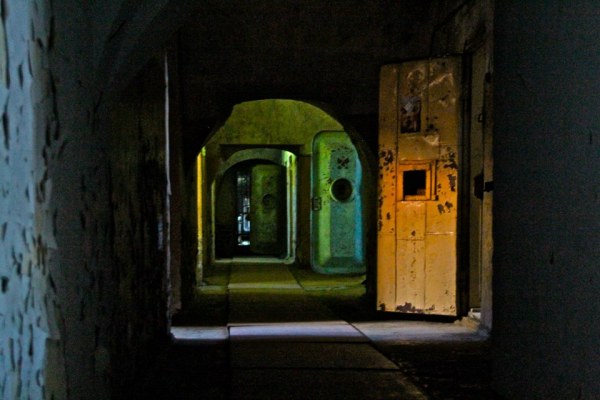
Fort Vaux was built into a rock formation. It was starting to rain as we headed into the visitor’s entrance. The tour guide picked up an English handout from the visitor’s desk and gave it to me. The fort smelled musty from the dampness, and it was chilly. I met the Belgian man’s wife. She spoke English too. We headed into a dark exhibit area that held a few personal effects from the soldiers, and then walked into the main corridor of the fort that was illuminated by bare light bulbs spaced far apart. The rooms off the main corridor dropped into blackness. Some rooms had numbers corresponding with numbers on my handout sheet. We walked down the corridor to the right and viewed the hospital rooms, barracks filled with bunks, stairs leading down into a black abyss, and an escape tunnel. Puddles of water stood in the floor. The Belgian woman and I discussed what it must have been like for the soldiers trying to survive here in the winter. I expected to see a rat sneaking down the dark, dank corridor. 

There were many openings off the main corridor. A short distance from one opening was a large mound of dirt that was topped by a Latin cross, which was illuminated by a light bulb. It was a mass grave that ran parallel to the corridor we were walking through. As we continued to walk to the other end of the fort, we passed a chapel. I read my handout. During the war, the dead bodies were placed in this area and covered with lime. 

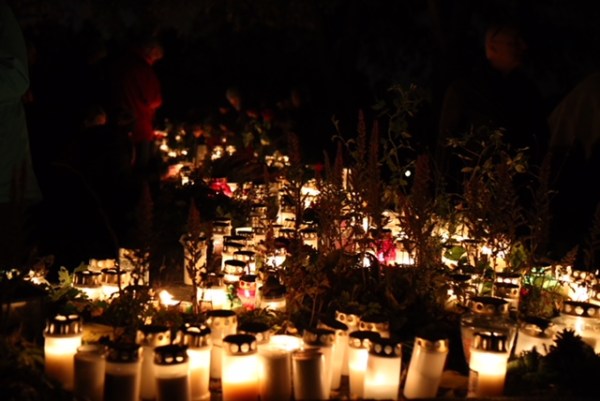
Later, the area was bricked up. The bodies remain behind the wall. The area in front of the wall was transformed into a chapel. A few candles were burning. I lit a candle for the unknown French soldiers and said a prayer of remembrance for them. 

The tour congregated in the gun room where the rusty gun remained. The large barrel stuck out through a hole in the fort’s wall. I looked out another opening and saw a choppy, turbulent sea of earth under thick hovering gray fog. Each hillock was created by bombs. I’ve always heard of “no man’s land,” and here it was. Time stood still. It was untouchable, and desolate. The land was lifeless, and nothing moved but the fog. The tour moved on and took us all away from the lookout across the war zone. 

We returned to the visitor’s center at Fort Vaux. I bought postcards of WWI soldiers at the Ossuary on Remembrance Day. Before returning to the bus, I walked to the edge of the parking lot and took a picture of the landscape. I was amazed that no one else seemed to pay attention to the land surrounding us. The land had been free from war since 1919 yet the effects of the war continued to haunt it. The parking lot was the only leveled ground in sight. Deep bomb craters were everywhere, and they were staggering. The trees were small saplings; the trunks were no larger than a woman’s wrist. I thought of the trees back home that were over fifty years old: The oaks, elms and maples towered above the streets and their branches reached out like a grandmother’s open arms. 

Pigeon Rings

The next stop on the tour was the Memorial of Verdun that displayed relics from both the French and German sides. There were hats, uniforms, ammunition, guns, documents, and pictures. We were herded into the auditorium to watch a film, In the Soldiers Footsteps. I received a headset that translated the audio into English. A blur of faces and troops is what I can remember most, not the words. Although I do remember a statement,

“These soldiers were men with a different character; strong men who walked into a battle knowing they would die.” They knew they would die. This was the truth of their war. 

I was intrigued by the display in the center of the memorial of razed earth as it might have been in 1916 – cratered and scattered with the remains of war and void of the presence of life. I tried to visualize the entire region of Verdun as depicted here. I discussed this scene with the Belgian couple, and then the Belgian man told me the story of his grandfather who was killed by the SS (Schutzstaffel) during WWII. 

His mother was 14 the day she opened the door to discover the SS or “Nacht-und nebelgefangenen” (Soldiers of the night and fog) on their porch. Along with being a doctor and a mayor, his grandfather made pigeon rings that were attached to a carrier pigeon’s leg. Carrier pigeons were an important method of communication in WWII. The Nazis wanted to kill all the French pigeons to help stop French communication. 

The SS had issued the command for the French to bring either the pigeon or the ring to them. (When they had the ring from the pigeon’s leg, they knew the pigeon was dead.) A member of the resistance had asked the doctor to help him make an extra ring for his carrier pigeon. Then he could give the Nazis the fake ring and would still have his pigeon to send messages. The doctor said he would do this but asked him not to tell anyone. The Belgian man added, “I’m not sure how many rings my grandfather made for the resistance, but this is why the SS took him away.” 

When the SS took the doctor to prison, his wife was pregnant with their fifth child. The doctor was killed in 1944 and never saw his son. Fifty years later, in 1994, the Germans wanted to reconcile and the Belgian man and his family went to the prison. His grandmother and uncle (the son who never saw his father) did not. She never remarried, and her life changed dramatically from being the wife of a doctor and mayor to being a widow with five children. The Germans returned letters that his grandfather wrote in prison but were never mailed by the SS. In the letters, the doctor spoke about the child his wife was carrying. 

Continue reading “Joining the ‘Champ de Bataille’ “

The Way to Verdun

May 1: I had to leave my hotel early to catch the train leaving from the Gare l’Est station to Nancy. The front desk had warned me that few places would be open due to the French Labor Day on May 1.

They were selling lily of the valley bouquets in Gare l’Est to celebrate Labor Day. I wanted to buy a bouquet, but decided I was carrying enough as I navigated through the train station. Read more: The train to Nancy

May 2: When I checked out of the hotel in Nancy, the woman at the front desk gave me a small bouquet of lily of the valley. She explained the flowers symbolized good luck. It seemed like a good omen to me as I left for my final destination where I would enter Cote 304 to face the unknown fire. 

Continue reading “The Way to Verdun”

Starting Point: At the heart of the Star (Place d’Etoile)

April 30: I was walking clockwise from Avenue Kleber around Place Charles de Gaulle (also known as Place d’Etoile) in search of the tunnel that would lead me under the busy roundabout that surrounds the Arc de Triomphe. I found the tunnel at Avenue de la Grande Armee and descended into the corridor, which was surprisingly deserted of people. There was a nicely dressed Frenchman about twenty paces ahead of me. He paid no heed to the sign in French that was posted on the partially closed gate, but pushed it open and kept walking.

I followed him. As I walked deeper into the empty tunnel, I realized that following a man I didn’t know, through a deserted tunnel, in a foreign country was not exactly a smart move for an American woman traveling alone. And feeling confident that I would scream for help if something did go wrong was ridiculous. Who would hear my screams in an empty tunnel? I had arrived in Paris only a few hours earlier and now marveled at my lack of decision-making skills. I needed to wake up. I chalked up my actions to jet lag and promised myself to pay better attention to what was going on around me.

Continue reading “Starting Point: At the heart of the Star (Place d’Etoile)”

What grows in 25 years

25 years ago today, April 29, I was on a plane heading to Paris for five days in France, specifically to visit Cote 304 and Verdun.

Back then, I was writing what would become “Resurgam—Standing on the Ground of Remembrance.” On the surface, it looked like a war story but it was much more than that. The wood line I had envisioned in Alpha Company’s story seemed very similar to Cote 304. I wanted to know if Cote 304 was the ground I had imagined. I learned about Verdun on December 25 while looking through a tour book on France and by February 20 decided to go there. It made no sense why a place completely devastated by war intrigued me. The verdant land had been slaughtered by war. And yet poppies flourished on the war-torn ground in France. During my WWI research in February 1998, bits of the poem I read “In Flanders Fields” by John McCrae would drift into my thoughts.… we are the Dead. Short days ago we lived, felt dawn, saw sunset glow. Loved and we loved, now we lie in Flanders Fields… 

I wondered what story I would discover when I remembered the unknown soldiers from WWI. The words of John McCrae’s poem continued to draw my attention:
Take up our quarrel with the foe: 
To you from failing hands we throw 
The torch; be yours to hold it high. 
If ye break faith with us who die 
We shall not sleep, though poppies grow 
In Flanders field

The words seemed to be speaking directly to me. The writer in me wanted to go to uncover the story in Verdun. Yet another side of me didn’t want to go face the darkness.

Deep within my gut I knew the step I had to take. And I did. No one else wanted to go, so I went alone. I prepared with great diligence for a trip to Verdun, the site of the longest and most devastating battle in WWI.

Continue reading “What grows in 25 years”

They lived. They loved. They have a story to tell

Remember
You are the hands of the present generation.
You hold the hands of a future generation.
You hold the hands of past generations, some now departed, and they in turn held the hands of older generations.
Hearts that once beat with life still beat in remembrance.
 

It is All Souls’ Day, a day not recognized through the spring and early summer of my life.  Since writing the words above as the Foreword of Resurgam – Standing on the Ground of Remembrance in 2008, there have been the departures of older generations and the arrivals of younger generations.

Now it’s a day with meaning, a day to pause, to remember them and reflect on all those hands and hearts that once walked on this earth and cultivated the ground in so many loving ways. All the unseen actions that went unrecognized yet made a difference in the future, which has become the present. 

To honor them and remember them, I’m sharing “Stones Unknown,” about finding peace in the most unexpected place. The inspiration (not surprisingly) was a stone.  This is a chapter from the revised story—The Ground of Remembrance—the fruit received through cycles of seasons from the hearts and hands of older generations. As the early story of Resurgam goes, “They lived. They loved. They have a story to tell.” I have been listening and learning. This small, yet new chapter took 25 years of learning how to listen and trust my heart. It is the beginning.  My heart overflows with gratitude for a gift from past generations that continues to grow.

Read: Stones Unknown

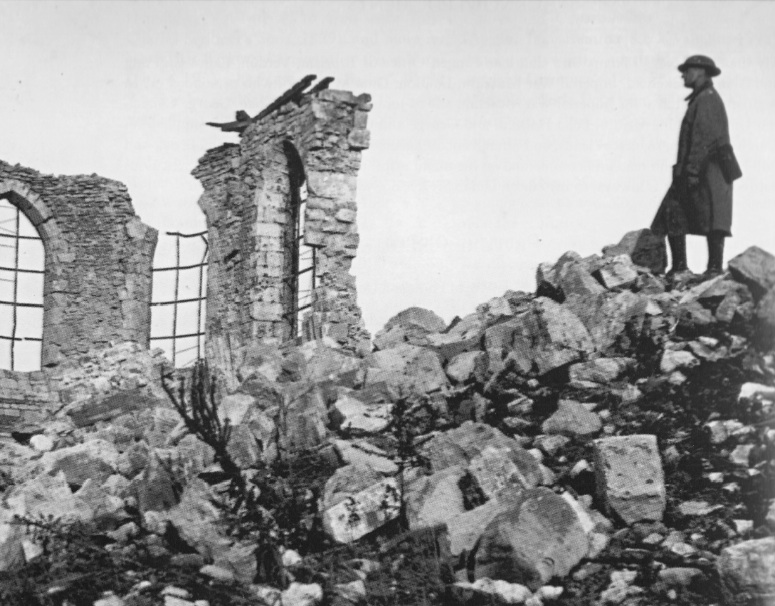
Background: A photograph of a solitary soldier standing on a hill of ruins captured my attention in 2013. (Hill of Loss) Something was familiar. The caption revealed the location: “A solitary American soldier looks at a ruined church on the crest of Montfaucon, France, after the town was captured.” I had been to there! My guide took me to Montfaucon on my way to Cote 304. That discovery and the journey inspired a new chapter of fiction, Stones Unknown in 2022.

From the book “RESURGAM – Standing on the Ground of Remembrance” – the discovery of Montfaucon, France (and the Center for Peace):

(c) 2022 Jean Niedert, an excerpt from “The Ground of Remembrance”

Pax (peace) in Montfaucon

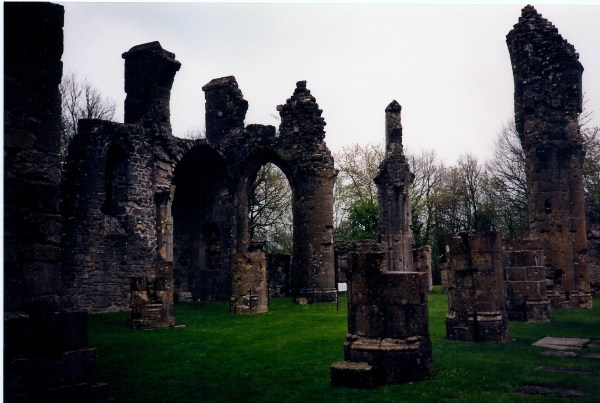
It’s a notable discovery when a single nugget of information ‘suddenly’ transforms a place. This summer I found a new connection to an old story. Turns out there was a Benedictine monastery in Montfaucon, France. It was destroyed in World War I although some church ruins remain.

There would have been a main entrance to the grounds of the former Benedictine monastery founded in the 6th century. Over the archway would have been the message: Pax intrantibus—Peace to those who enter here. (Or perhaps just Pax.)

Continue reading “Pax (peace) in Montfaucon”

Discovering the Oratory of the Heart

Joan Chittister writes: “… you have to make an oratory for yourself somehow. Take a long walk alone, perhaps, where the whipping wind or the bursting of trees can bring you back to the essentials, the basics of life. The point is that your “oratory” is whatever invites you, lifts your soul beyond the daily and the mundane. The oratories of the heart are any place that recalls you to your spiritual self.”

I have continued to return to Joan Chittister’s words in the chapter “The Oratory – On Holy Space” from her book The Monastic Heart.

I landed in the oratory during February and continued to return to the pages due to its resonance. Why do these words speak to me? Initially, I thought it was the discovery of the word, “oratory” for chapel. I remembered the Chapel of the Palms. This small, simple oratory sits by the Edisto River, which flows—within eyesight—into the Atlantic Ocean.   To be there—even on the ground of remembrance—is to notice hidden transitions.

And still, the oratory resonated, so I wanted to share this chapter with others. It was the timing of my decision to share that finally illuminated a deeper understanding and meaning. 

March 13, 2022, the two-year mark

It is March 13, 2022, the two-year mark since all organized activities were cancelled for two weeks in March 2020 due to the unknowns of COVID virus. Those two weeks transformed into a stay at home mandate in April 2020. Routines were swept away and life upended.

As I reflected on those early months, I realized the oratory speaks to my heart and spirit because I created an oratory but wasn’t aware of the creation until I read about the oratory. 

Now I understand that COVID restrictions didn’t block access to this space. Visiting hours remained open. There wasn’t any mask mandate.  The only requirement was to find time to visit—to pause, to settle, to rest, to find peace—and finally, to be at peace.  

I entered a variety of oratories during these two years.  There was a back yard deck, the detailed memory of the Chapel of the Palms by the water, the neighbor’s backyard garden with the koi pond, a friend’s covered dock with unexpected sightings of dolphins, walks on the beach, a porch swing on a river walk, a bench at a church’s columbarium, a yoga mat, but most importantly, the space within the heart. In these past two years, I have visited the oratory in my heart more than I have ever visited it before. Maybe that’s the truth I needed to discover this week as the world faces another challenge.  And this I know with great certainty in this uncertain world: There is an expansive network of hidden oratories. The community of prayer has grown stronger during these two years.  Where is your oratory? How many have you created and visited during these past two years? 

Excerpts from “The Oratory – On Holy Space” from Joan Chittister’s book The Monastic Heart:

… Now, in these times, we are at the very same kind of moment: Churches are closing as congregations move or disappear. Massive cathedrals stand alone in the cities, still cavernous, too often empty. Now, perhaps more than ever, we need to “let the oratory be what it is called.” We must let it call us beyond our present overwhelmed selves. What will happen to our hearts if there is no place for us to find the beauty of emptiness in an overstuffed world? We live in an overnoisy, overcrowded, overstimulating round of events, with hardly a break to think through the important questions of life: What is life about? What is the purpose of our lives? How can we possibly make things better, more whole, for our families, for our world, for ourselves?

… The oratory tells you that you yourself must reach out, stop, sink down inside yourself, and let the weariness, the pain, the fear of abandonment evaporate and go to dust in the presence of the soothing warmth of faith and the promises of security, beauty, joy, and happiness that come with the presence of God in your life. 

Helping the Human Spirit in Its Search for Peace

Today is Father’s Day. Ten years ago while in a bookstore in Highlands, North Carolina, an orange leaf on a book cover caught my attention. I read the title “Parting – A Handbook for Spiritual Care Near the End of Life.” 

My initial thought, “It’s too late for that book.” My dad had passed away in April and the grief was raw in June.  I had believed he would live for many more decades due to his love of life and learning. But everyone was blindsided when he was diagnosed in March.  

Instead of passing by the book, I picked it up and read the Foreword, which included:

… Spiritual care for the purpose of this handbook is soul care, helping the human spirit in its search for peace. It is the attempt to help those near the end of life feel whole, fulfilled, and in harmony with their world and higher power. Religious experience may or may not be spiritual, and spiritual experience may or may not be religious. Regardless of the dying person’s religion or persuasion or faith tradition, spiritual care near the end of life supplies a deep human need.

My personal grief provided an heightened awareness of the collective grief. My dad had ensured everything was in order, but that orderliness didn’t lessen the grief, sorrow or the immense loss I felt and experienced.

Continue reading “Helping the Human Spirit in Its Search for Peace”

Finding the Neutral Zone of Transition

“It isn’t the changes that do you in, its the transitions. They aren’t the same thing. Change is situational: the move to a new site, the new boss, the revisions to plans. Transition is psychological; it is a three-phase process that people go through as they internalize and come to terms with the details of the new situation that the change brings”. –William Bridges from the book “Managing Transitions”.

What Happens When Your World Changes?

The lifting of the Stay at Home order only intensified change. The new reality was evident in every outside interaction. Continue reading “Finding the Neutral Zone of Transition”

Paying Attention to the Known and Unknown of Life


My creative meander in March that started with Receiving the Precious Gift of Time led me back to familiar ground in June. During the uncertainty and upheavals between March and June, I revisited chapters from “A Year to Live” by Stephen Levine. Noticing, Gratitude and A Commitment to Life helped me befriend the unknown. His book provided hope and structure during the months of change out of my control. Here’s the first paragraph from the Introduction:

This is a book of renewal. It is not simply about dying but about the restoration of the heart, which occurs when we confront our life and death with mercy and awareness. It is an opportunity to resolve our denial of death as well as our denial of life in a year-long experiment in healing, joy, and revitalization.

When my calendar was cleared in March, I felt the loss of routine and social interaction. I was naively hopeful, expecting that we would return to something new in April. There was no return in April but there was something new: Stay At Home orders.

With nowhere to go, few distractions, I kept writing about what I encountered during the global pandemic. Changes out of my control and transitions experienced during long-distance caregiving and end of life care (2010-2017) helped me in many ways during the Stay at Home months. I had experienced a micro of this unexpected macro that started in March.

Ten years ago, an orange leaf on the front cover of a book caught my attention while browsing in a bookstore. I saw the title “Parting” and then “A Handbook for Spiritual Care Near the End of Life.”
My initial thought, “It’s too late for that book.” My dad had passed away in April 2010 and my grief was raw in June 2010. I had believed he would live into his nineties due to his love of life and learning. Everyone was blindsided when he was diagnosed in March and offered a hopeful prognosis.

Instead of dismissing the book, I picked it up and read the Foreword, which included: …Spiritual care for the purpose of this handbook is soul care, helping the human spirit in its search for peace. It is the attempt to help those near the end of life feel whole, fulfilled, and in harmony with their world and higher power. Religious experience may or may not be spiritual, and spiritual experience may or may not be religious. Regardless of the dying person’s religion or persuasion or faith tradition, spiritual care near the end of life supplies a deep human need.

I bought the book that day in 2010 and read it during Father’s Day weekend. An odd thing to do—dive into the dying, but my motivation was to dissect the misery and what had transpired in forty days. I needed to understand and “helping the human spirit in its search for peace” offered a light of peace in the unfamiliar darkness that descends with death. I accepted the light. It was as gentle as a single candle flame.

Found of page 3 in Parting:

One physician says that the best way to improve spiritual care for the dying is to improve it for the living. All too often, the day-to-day business of life gets in the way of the inner life. Death clears the calendar; it uncrowds life so that spiritual needs come to the forefront.

I asked myself, “Why wait? Why wait until end of life to pay attention to our spiritual needs? Why not now?” These questions have stuck with me since 2010. Time and time again, I cycled through change and transition due to a loss or a death. I would find peace and then lose it. Some “thing,” or connection, seemed to be missing.  The physician touched upon it in “Parting”, the day-to-day business of life gets in the way of the inner life. In March 2020 there was suddenly time to pay attention to the inner life. The two-week “hold” that transformed into a Stay at Home order was lifted on May 22. Plans for 2020 died. The death of the familiar day-to-day routines cleared the calendar.  Ways of doing changed. Ordinary events were no longer ordinary (or no longer existed). There have been many endings and each ending carried varying degrees of loss and grief. There was familiarity but disconnection, and a lot of unknown. The outside world looked the same, but there was an unseen hill of loss.

I had been here before.

And so Levine’s words return, replacing book with journey, and dying with what has died:

This is a journey of renewal. It is not simply about (what has died) but about the restoration of the heart, which occurs when we confront our life and death with mercy and awareness. It is an opportunity to resolve our denial of death as well as our denial of life in a year-long experiment in healing, joy, and revitalization.

Next: The Intimate Familiarity of a Place Known is the Not Knowing Place


The Power of “Remember Them” – They Continue to Live and Become “Known”

In memory and in honor of the unknown soldiers of Alpha Company, many who became known due to the efforts of Phil Woodall. An excerpt from his first letter, so many years ago:

Dear Jean,
East 47 has an answer – the letter to Alpha Company is a poem. It is attached for you. I placed it at the base of panel 47 because on rows five and six are three Alpha Company members: Lt. Gary Scott, Lt. Frank Rodriquez, and PFC Manuel Ruiz – all killed March 29, 1968 in a paddy around Hue. The dates are documented in the book “Dear America,” excerpted from a letter that I wrote my Dad on April 5, 1968; the day after Martin Luther King was slain.

Continue reading “The Power of “Remember Them” – They Continue to Live and Become “Known””

Gifts that Keep Giving

I just cycled back to Phil Constineau’s pilgrimage to Angkor Wat. I bought The Art of Pilgrimage when it was just published in 1998.  Only recently I recognized the deeper connections: Angkor Wat was the center of Phil’s book, and the spark that would light his travelers lamp was a book from Phil’s dad.

This book quietly illuminates the full circuit of a living gift.  It keeps giving and the reach continues to expand.

Discovering the Hidden Beauty of the World

Phil received the book about Angkor Wat on his eleventh birthday.  It wasn’t a gift he had asked for, but the bronze-tinted book depicted sculptures of the long forgotten world of the Khmers that transported the eleven-year old beyond known boundaries. Continue reading “Gifts that Keep Giving”

Life’s Reflection at 47E – the Interconnectedness of One Veteran’s Action to Remember Them

I visited 47E at the Vietnam Veterans Memorial on Labor Day. It’s been over two decades since my last visit. The photo is my attempt to capture the light, life’s reflections and the promise of RESURGAM, which is a vast interconnectedness that keeps weaving through time.

As for words, remembering Phil Woodall is important. His name is not on the Vietnam Veterans Memorial. He’s the Vietnam veteran who drew my attention to 47E with two written words: Alpha Company.

Continue reading “Life’s Reflection at 47E – the Interconnectedness of One Veteran’s Action to Remember Them”

Look with the Heart, Not the Eye of a Stranger

So much truth in the words from the banquet speech of the 2015 Nobel Prize Winner in Literature, Svetlana Alexievich.

“Why do I write? I have been called a writer of catastrophes, but that isn’t true. I am always looking for words of love. Hate will not save us. Only love. And I have hope.

… In one Belarusian village, an old woman bade me farewell with the following words: “Soon we will go our separate ways. Thank you for listening to me and for conveying my pain to other people. I beg you, as you leave, to have a look at my little cabin not only once, but twice. When a person looks a second time, it is not with the eye of a stranger, it is a look with the heart …”

(Excerpts are from Svetlana Alexievich’s banquet speech during the Nobel Prize Banquet on December 10, 2015)

Continue reading “Look with the Heart, Not the Eye of a Stranger”

“We lose track of time and of place, we move into a timeless time and a placeless space when we are in a creative state. Afterward, we know we have tasted something worth remembering, something that will last. And often we have a special gift to bestow on others because of the journey we have undergone in our creative work.” —From the book “Creativity” by Matthew Fox.

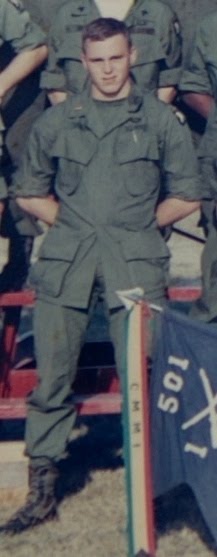
Ten years ago—July 28, 2009—a fierce thunderstorm raged outside. The lightening was so intense, I decided to unplug all electronic devices and read a book. Unexpectedly, the image of a soldier dressed in combat fatigues flashed in my imagination as vividly as the lightning outside.

Soldier dressed in combat fatigues

Continue reading “Why I Wrote about Standing in No Man’s Land during the WWI Christmas Truce”

Blog at WordPress.com.

Up ↑