Field Notes

The rill garden: a place of enchantment

If you’re not familiar with the rill garden created by Geoffrey Jellicoe, here’s a lovely introduction that provides sight and sound.

Watch: Shute Garden (4:16 mins) This is a BBC video clip from episode 4 of “The Secret History of the British Garden” by Monty Don.

The moment Monty Don and Suzy Lewis passed through the gate of Shute House Garden, I was instantly transported to a place of enchantment. The water is channeled from the River Nadder into a series of canals, pools and waterfalls. It pours down a series of copper chambers in the rill which create different notes on the musical scale.

Continue reading “The rill garden: a place of enchantment”

Sound: Warm as sunlight… a calming, centering glow

David George Haskell writes: “A tone clear and warm as sunlight sounds from the giant bronze bell. The ring contains no hint of clang or jangle, just a single frequency, sweetened and fattened by overtones, pitched a few notes below middle C, exactly at the midpoint range of human speech. 

His words create a sound.  I imagine listening to this bronze bell while wondering where it might be. 

Haskell continues: Although I stand two meters away from the bell, the sound seems to emerge from within me, a calming, centering glow that spreads from chest to extremities, then flows outward into my perception of the park which I stand. 

Haskell reveals he’s standing in Hiroshima Peace Park listening to the Peace Bell, which visitors can ring. The resonate sound of the peace bell arrived in my imagination and awareness. I heard it. Here’s a different version of place making and peace making—of cultivating sound and a sense of peace.

“A child stands on tiptoe and reaches up to haul on a rope dangling from the beam. She pulls back, then releases, and the wooden striker swings onto the bell. The sound rings again. Pure and steady toned, with a slight pulsation, a swelling of amplitude that comes at a pace just slower than a calm heartbeat.” 

David George Haskell writes about the Peace Bell, it’s maker, Masahiko Katori and introduces the 100 Soundcapes of Japan in his book, Sounds Wild and Broken—Sonic Marvels, Evolutions Creativity and the Crisis of Sensory Extinction.” He notes the ringing of the Peace Bell is Soundscape 76.  

The 100 Soudscapes of Japan is a government program launched in 1996 to combat noise pollution, to honor significant soundscapes and to prompt people to rediscover the natural sounds around them and encourage deeper listening.

Haskell reminds us, “The wonders of human culture and the living world come to us through many senses. To only honor material objects and spaces is to exclude much of what gives life joy and meaning.”

I pause to recognize how much sound gets cast into the background, and yet, it’s often the sounds of nature that give life joy and spark a sense of wonder.

Wikipedia: 100 Soundscapes of Japan

Read an excerpt from David George Haskel’s book that’s repurposed as an article in Spirituality and Health:  100 Sounds and a Culture of Listening

What will happen to our hearts if there is no place to find the beauty of emptiness in an overstuffed world? “ – Joan Chittister

Finding a sheltering space (not a coffee shop)

In my creative meanders, this garden visit was on a whim. (Proving “yes” is the best response to an encouraging inner nudge to explore something unknown or forgotten.)

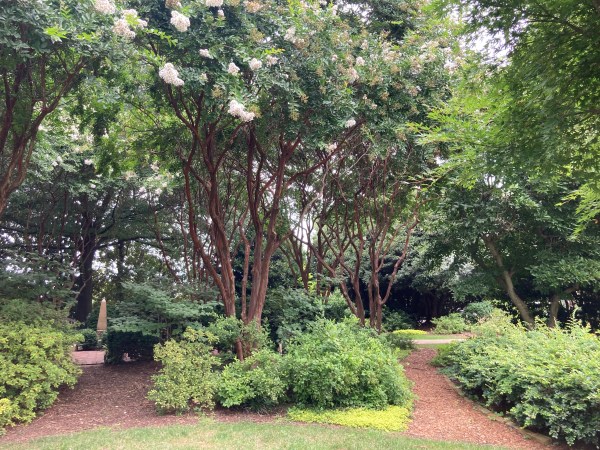
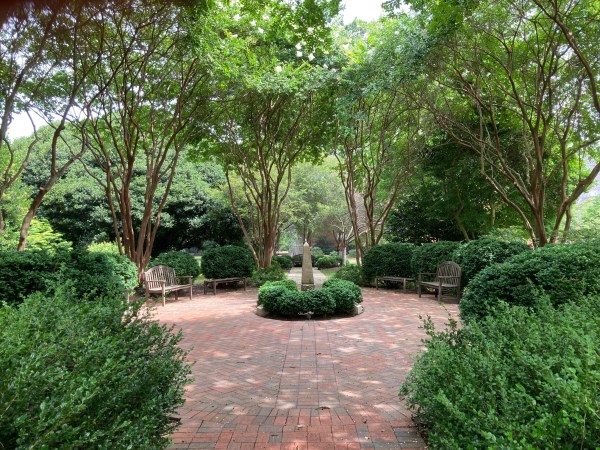
I entered a canopy of white crepe myrtles that created a sheltering space. It seemed as if two hands held an offering to any visitor. I sat on a bench and listened. The gentle bubbling of the fountain, the birdsong, the wind rustling leaves. I watched the water run down the side of the marble fountain. It was a place of peace. I felt unexpectedly happy as my eyes explored this space of details easily missed by sweeping surface glances. 

Continue reading “Finding a sheltering space (not a coffee shop)”

Learning about restorative gardens

Taking the Introduction to Therapeutic Horticulture course (online) during May-July enabled me to see the “hidden” structures in gardens. Of course, the structure is always in clear view, but I haven’t attended to those details until now. 

My interest has landed on restorative gardens, the characteristics in healing gardens and the therapeutic power of beauty.  Here’s what holding my attention this month:

Four phases of interaction in nature (addressed in Johan Ottosson’s doctoral thesis, The Importance of Nature in Coping):

  • Phase I – Inert objects
  • Phase II – Plants and greenery 
  • Phase I + II – Nature 
  • Phase III – Animals 
  • Phase IV – People 

Eight characteristics of a restorative garden (Grahn, 1991) (Stigsdotter 2015):

  1. Serene
  2. Wild
  3. Rich in species
  4. Space
  5. The common
  6. The pleasure garden
  7. Festive 
  8. Culture
Continue reading “Learning about restorative gardens”

Placemaking inspires reinvention

From the Project for Public Spaces: Placemaking inspires people to collectively reimagine and reinvent public spaces as the heart of every community. Strengthening the connection between people and the places they share, placemaking refers to a collaborative process by which we can shape our public realm in order to maximize shared value. More than just promoting better urban design, placemaking facilitates creative patterns of use, paying particular attention to the physical, cultural, and social identities that define a place and support its ongoing evolution.

When you focus on place, you do everything differently

Read more from Project for Public Spaces: What is Placemaking?

You’ll find a Placemaking booklet on the PPS page that you can download.

Discovering “place maker” and contemplating “peace maker”

“I feel called to be a ‘place maker’ to set down roots in a society that is constantly on the move.” – H.D.

My introduction to “place maker” arrived when I read H.D.’s forum post regarding her interest in therapeutic horticulture as the course ends.  My mind kept playing with “l” and “e”: place maker | peace maker.  I could see the interconnectedness in the interplay of place and peace.

What else could I find?

Continue reading “Discovering “place maker” and contemplating “peace maker””

The plant would still be distinguished… and that in itself is its own reward

“Struggling over steep hills covered with hedgerows, trees, and generally impenetrable jungle, one of my men turned to me and pointed a hand, filled with cuts and scratches, at a rather distinguished-looking plant with soft red flowers… – Sandy Kempner

I received an email on Friday and learned an acquaintance was reading Resurgam. Although he was on page 39, he offered feedback, which included:  “Phil, we learn, is a poet, but there is also Sandy’s beautiful and profound letter.  The reader is led not simply to hear such voices respectfully but to think along with their spirit.  His cherished plant among the blasted warscape provoked in me this remembrance of Whitehead’s words….

With the mention of Sandy Kempner’s letter, the plant with red flowers waving gaily in the downpour and the tired Marine who wrote the letter arrived in my memory.  What timing.

Beauty as a form of emotional nourishment

This letter records beauty as a form of emotional nourishment. Originally, I found Sandy’s letter in the early months of my search for Alpha Company way back in my late twenties. For me, so much was unknown and there were many battles with doubt at that time. The unexpected beauty described in Sandy’s letter offered a completely different perspective. 

Continue reading “The plant would still be distinguished… and that in itself is its own reward”

Beauty as seen by Sandy Kempner

“It makes a sound, and the plant was beautiful, and the thought was kind, and the person was humane, and distinguished and brave, not merely because other people recognized it as such, but because it is, and it is, and it is.

Dear Aunt Fannie,
This morning, my platoon and I were finishing up a three-day patrol. Struggling over steep hills covered with hedgerows, trees, and generally impenetrable jungle, one of my men turned to me and pointed a hand, filled with cuts and scratches, at a rather distinguished-looking plant with soft red flowers waving gaily in the downpour (which had been going on ever since the patrol began) and said, “That is the first plant I have seen today which didn’t have thorns on it.” I immediately thought of you. 

Continue reading “Beauty as seen by Sandy Kempner”

Discovering the Oratory of the Heart

Joan Chittister writes: “… you have to make an oratory for yourself somehow. Take a long walk alone, perhaps, where the whipping wind or the bursting of trees can bring you back to the essentials, the basics of life. The point is that your “oratory” is whatever invites you, lifts your soul beyond the daily and the mundane. The oratories of the heart are any place that recalls you to your spiritual self.”

I have continued to return to Joan Chittister’s words in the chapter “The Oratory – On Holy Space” from her book The Monastic Heart.

I landed in the oratory during February and continued to return to the pages due to its resonance. Why do these words speak to me? Initially, I thought it was the discovery of the word, “oratory” for chapel. I remembered the Chapel of the Palms. This small, simple oratory sits by the Edisto River, which flows—within eyesight—into the Atlantic Ocean.   To be there—even on the ground of remembrance—is to notice hidden transitions.

And still, the oratory resonated, so I wanted to share this chapter with others. It was the timing of my decision to share that finally illuminated a deeper understanding and meaning. 

March 13, 2022, the two-year mark

It is March 13, 2022, the two-year mark since all organized activities were cancelled for two weeks in March 2020 due to the unknowns of COVID virus. Those two weeks transformed into a stay at home mandate in April 2020. Routines were swept away and life upended.

As I reflected on those early months, I realized the oratory speaks to my heart and spirit because I created an oratory but wasn’t aware of the creation until I read about the oratory. 

Now I understand that COVID restrictions didn’t block access to this space. Visiting hours remained open. There wasn’t any mask mandate.  The only requirement was to find time to visit—to pause, to settle, to rest, to find peace—and finally, to be at peace.  

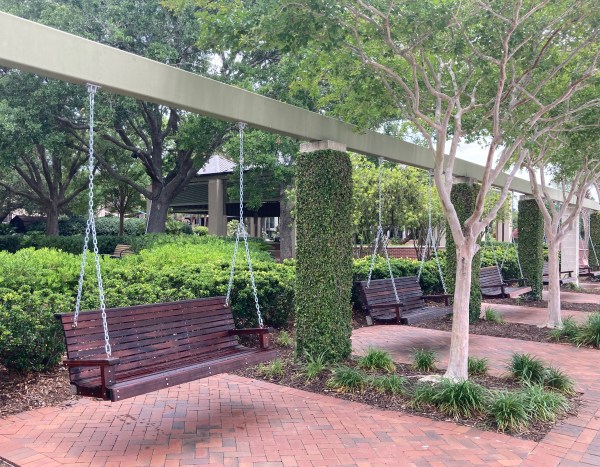
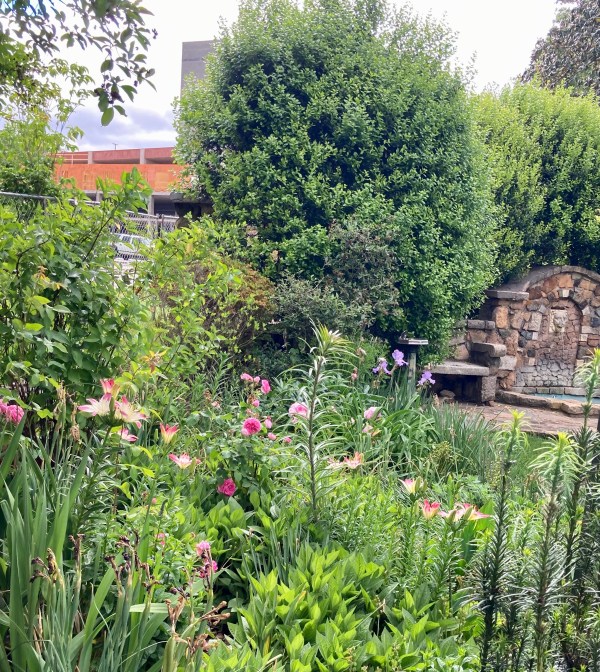
I entered a variety of oratories during these two years.  There was a back yard deck, the detailed memory of the Chapel of the Palms by the water, the neighbor’s backyard garden with the koi pond, a friend’s covered dock with unexpected sightings of dolphins, walks on the beach, a porch swing on a river walk, a bench at a church’s columbarium, a yoga mat, but most importantly, the space within the heart. In these past two years, I have visited the oratory in my heart more than I have ever visited it before. Maybe that’s the truth I needed to discover this week as the world faces another challenge.  And this I know with great certainty in this uncertain world: There is an expansive network of hidden oratories. The community of prayer has grown stronger during these two years.  Where is your oratory? How many have you created and visited during these past two years? 

Excerpts from “The Oratory – On Holy Space” from Joan Chittister’s book The Monastic Heart:

… Now, in these times, we are at the very same kind of moment: Churches are closing as congregations move or disappear. Massive cathedrals stand alone in the cities, still cavernous, too often empty. Now, perhaps more than ever, we need to “let the oratory be what it is called.” We must let it call us beyond our present overwhelmed selves. What will happen to our hearts if there is no place for us to find the beauty of emptiness in an overstuffed world? We live in an overnoisy, overcrowded, overstimulating round of events, with hardly a break to think through the important questions of life: What is life about? What is the purpose of our lives? How can we possibly make things better, more whole, for our families, for our world, for ourselves?

… The oratory tells you that you yourself must reach out, stop, sink down inside yourself, and let the weariness, the pain, the fear of abandonment evaporate and go to dust in the presence of the soothing warmth of faith and the promises of security, beauty, joy, and happiness that come with the presence of God in your life. 

Helping the Human Spirit in Its Search for Peace

Today is Father’s Day. Ten years ago while in a bookstore in Highlands, North Carolina, an orange leaf on a book cover caught my attention. I read the title “Parting – A Handbook for Spiritual Care Near the End of Life.” 

My initial thought, “It’s too late for that book.” My dad had passed away in April and the grief was raw in June.  I had believed he would live for many more decades due to his love of life and learning. But everyone was blindsided when he was diagnosed in March.  

Instead of passing by the book, I picked it up and read the Foreword, which included:

… Spiritual care for the purpose of this handbook is soul care, helping the human spirit in its search for peace. It is the attempt to help those near the end of life feel whole, fulfilled, and in harmony with their world and higher power. Religious experience may or may not be spiritual, and spiritual experience may or may not be religious. Regardless of the dying person’s religion or persuasion or faith tradition, spiritual care near the end of life supplies a deep human need.

My personal grief provided an heightened awareness of the collective grief. My dad had ensured everything was in order, but that orderliness didn’t lessen the grief, sorrow or the immense loss I felt and experienced.

Continue reading “Helping the Human Spirit in Its Search for Peace”

“It is a time when all the old clarities break down and everything is in flux. Things are up in the air. Nothing is a given anymore, and anything could happen. No one knows the answers: one person says one thing and someone else says something completely different.” (William Bridges)

That description seems to fit the world in the present day. I know I’m in the middle phase of the transition process due to the global pandemic and the changes it has sparked and catalyzed. William Bridges calls this time the Neutral Zone, because “it is a nowhere between two somewheres, and because while you are in it, forward motion seems to stop while you hang suspended between was and will be.” 

As I study transitions, I recognize the Not Knowing Place is part of my transition process. In the past I placed too much emphasis on getting out of the Not Knowing Place. Bridges writes, “when change is deep and far-reaching, this time between the old identity and the new can stretch for months, even years.”

I noticed that time became fluid during the pandemic/Stay at Home order and the boundaries of time (such as self-imposed deadlines and schedules) washed away. Continue reading

Finding the Neutral Zone of Transition

“It isn’t the changes that do you in, its the transitions. They aren’t the same thing. Change is situational: the move to a new site, the new boss, the revisions to plans. Transition is psychological; it is a three-phase process that people go through as they internalize and come to terms with the details of the new situation that the change brings”. –William Bridges from the book “Managing Transitions”.

What Happens When Your World Changes?

The lifting of the Stay at Home order only intensified change. The new reality was evident in every outside interaction. Continue reading “Finding the Neutral Zone of Transition”

Standing in Paradox and the Tension of Opposites

As I continued to investigate the Not Knowing Place during the Stay at Home months, I remembered reading about standing in paradox and the tension of opposites in the book, “The Great Work of Your Life” by Stephen Cope:

“Marion Woodman writes, “We learn to live in paradox, in a world where two apparently exclusive views are held at the same time. In this world, rhythms of paradox are circuitous, slow, born of feeling rising from the thinking heart. Many sense such a place exists. Few talk or walk from it.”

Carl Jung’s developmental strategy for standing in paradox: One must hold both sides of a paradox at the same time without choosing one or the other. Exiling neither. Privileging neither. In this way, we can gradually learn to tolerate living in the tension of opposites.

Marion states the technique with stunning clarity: “Holding an inner or outer conflict quietly instead of attempting to resolve it quickly is a difficult idea to entertain. It is even more challenging to experience. However, as Carl Jung believed, if we held tension between the two opposing forces, there would emerge a third way, which would unite and transcend the two. Indeed, he believed that this transcendent force was crucial to individuation. Whatever the third way is, it usually comes as a surprise, because it had not penetrated our defenses until now. A hasty move to resolve tension can abort growth of the new. If we can hold conflict in psychic utero long enough we can give birth to something new in ourselves.”

Hold conflict in psychic utero. This is a skill that can be learned. But it requires a host of collateral skills that most of us in the west has not nurtured: the capacity to stand in the mystery; the capacity to tolerate the unknown; the courage to live in the wilderness for a while; the love of the dark and the night and the moon; the wisdom of the circle, not the line.”

The Intimate Familiarity of a Place Known is the Not Knowing Place

“The perfection is in the repetition, the sheer ordinariness, the intimate familiarity of a place known because we have visited it again and again in so many different moments.”

As I reread the words by Wayne Muller on April 8 while under a Staying at Home order, I recognized the intimate familiarity of “a place known,”  was the unknown.  I have spent a lot time writing about the unknown, but rarely valued its true worth. Throughout life, it served as a catalyst. I always wanted to know, to find the answer and take a step into knowing. Time spent not knowing was viewed as wasted time. The receptivity of “the gift of time” during March enabled me to recognize the Not Knowing Place. And as Muller suggested, I have visited it again and again in so many different moments. Through all the seasons, through all the years, through all the days, and even in the moments, I have found myself in the Not Knowing Place.  I actually “knew” this place! Continue reading “The Intimate Familiarity of a Place Known is the Not Knowing Place”

Paying Attention to the Known and Unknown of Life


My creative meander in March that started with Receiving the Precious Gift of Time led me back to familiar ground in June. During the uncertainty and upheavals between March and June, I revisited chapters from “A Year to Live” by Stephen Levine. Noticing, Gratitude and A Commitment to Life helped me befriend the unknown. His book provided hope and structure during the months of change out of my control. Here’s the first paragraph from the Introduction:

This is a book of renewal. It is not simply about dying but about the restoration of the heart, which occurs when we confront our life and death with mercy and awareness. It is an opportunity to resolve our denial of death as well as our denial of life in a year-long experiment in healing, joy, and revitalization.

When my calendar was cleared in March, I felt the loss of routine and social interaction. I was naively hopeful, expecting that we would return to something new in April. There was no return in April but there was something new: Stay At Home orders.

With nowhere to go, few distractions, I kept writing about what I encountered during the global pandemic. Changes out of my control and transitions experienced during long-distance caregiving and end of life care (2010-2017) helped me in many ways during the Stay at Home months. I had experienced a micro of this unexpected macro that started in March.

Ten years ago, an orange leaf on the front cover of a book caught my attention while browsing in a bookstore. I saw the title “Parting” and then “A Handbook for Spiritual Care Near the End of Life.”
My initial thought, “It’s too late for that book.” My dad had passed away in April 2010 and my grief was raw in June 2010. I had believed he would live into his nineties due to his love of life and learning. Everyone was blindsided when he was diagnosed in March and offered a hopeful prognosis.

Instead of dismissing the book, I picked it up and read the Foreword, which included: …Spiritual care for the purpose of this handbook is soul care, helping the human spirit in its search for peace. It is the attempt to help those near the end of life feel whole, fulfilled, and in harmony with their world and higher power. Religious experience may or may not be spiritual, and spiritual experience may or may not be religious. Regardless of the dying person’s religion or persuasion or faith tradition, spiritual care near the end of life supplies a deep human need.

I bought the book that day in 2010 and read it during Father’s Day weekend. An odd thing to do—dive into the dying, but my motivation was to dissect the misery and what had transpired in forty days. I needed to understand and “helping the human spirit in its search for peace” offered a light of peace in the unfamiliar darkness that descends with death. I accepted the light. It was as gentle as a single candle flame.

Found of page 3 in Parting:

One physician says that the best way to improve spiritual care for the dying is to improve it for the living. All too often, the day-to-day business of life gets in the way of the inner life. Death clears the calendar; it uncrowds life so that spiritual needs come to the forefront.

I asked myself, “Why wait? Why wait until end of life to pay attention to our spiritual needs? Why not now?” These questions have stuck with me since 2010. Time and time again, I cycled through change and transition due to a loss or a death. I would find peace and then lose it. Some “thing,” or connection, seemed to be missing.  The physician touched upon it in “Parting”, the day-to-day business of life gets in the way of the inner life. In March 2020 there was suddenly time to pay attention to the inner life. The two-week “hold” that transformed into a Stay at Home order was lifted on May 22. Plans for 2020 died. The death of the familiar day-to-day routines cleared the calendar.  Ways of doing changed. Ordinary events were no longer ordinary (or no longer existed). There have been many endings and each ending carried varying degrees of loss and grief. There was familiarity but disconnection, and a lot of unknown. The outside world looked the same, but there was an unseen hill of loss.

I had been here before.

And so Levine’s words return, replacing book with journey, and dying with what has died:

This is a journey of renewal. It is not simply about (what has died) but about the restoration of the heart, which occurs when we confront our life and death with mercy and awareness. It is an opportunity to resolve our denial of death as well as our denial of life in a year-long experiment in healing, joy, and revitalization.

Next: The Intimate Familiarity of a Place Known is the Not Knowing Place


Sabbath honors this quality of not knowing, an open receptivity of mind essential for allowing things to speak to us from where they are. If we take a day and rest, we cultivate Sabbath Mind. We let go of knowing what will happen next, and find the courage to wait for the teaching that has not yet emerged. The presumption of the Sabbath is that it is good, and that the wisdom, courage, and clarity we need are already embedded in creation. The solution is already alive in the problem. Our work is not always to push and strive and struggle. Sometimes we only have to be still, says the Psalmist, and we will know.
From the conclusion of the chapter Beginner’s Mind in the book, “Sabbath – Finding Rest, Renewal, and Delight in Our Busy Lives” by Wayne Muller.

And so, I allow these words to speak to me. I remember last week how the days started to melt together. It seemed like Wednesday but it was only Tuesday! There was a spike of panic, the worry of memory loss but then I turned away from that worry. Continue reading

The Power of “Remember Them” – They Continue to Live and Become “Known”

In memory and in honor of the unknown soldiers of Alpha Company, many who became known due to the efforts of Phil Woodall. An excerpt from his first letter, so many years ago:

Dear Jean,
East 47 has an answer – the letter to Alpha Company is a poem. It is attached for you. I placed it at the base of panel 47 because on rows five and six are three Alpha Company members: Lt. Gary Scott, Lt. Frank Rodriquez, and PFC Manuel Ruiz – all killed March 29, 1968 in a paddy around Hue. The dates are documented in the book “Dear America,” excerpted from a letter that I wrote my Dad on April 5, 1968; the day after Martin Luther King was slain.

Continue reading “The Power of “Remember Them” – They Continue to Live and Become “Known””

Turning to Prepare for the Journey into the Unknown

Every day, every year circles around the silent turning of cycles and rhythms.

This is no longer the hopeful two week sprint cycling back to the known. This is a challenging expedition into unchartered terrain.

I continue to downshift. Yesterday as the new “Stay At Home” order went into effect, I realized the need to adjust my “life retraction” schedule. Do I still need an alarm to wake me up at 5 AM? I decided no. I’ll honor my body’s inner clock and my need for rest.

When I was experiencing upheavals and uncertainty while my mother was under hospice care in 2015-2017, I discovered some tips for a household retraction (in the book, Home Comforts by Cheryl Mendelson) and saw how her advice also applied to a life retraction during that time. The “life retraction” advice seems helpful now.

Continue reading “Turning to Prepare for the Journey into the Unknown”

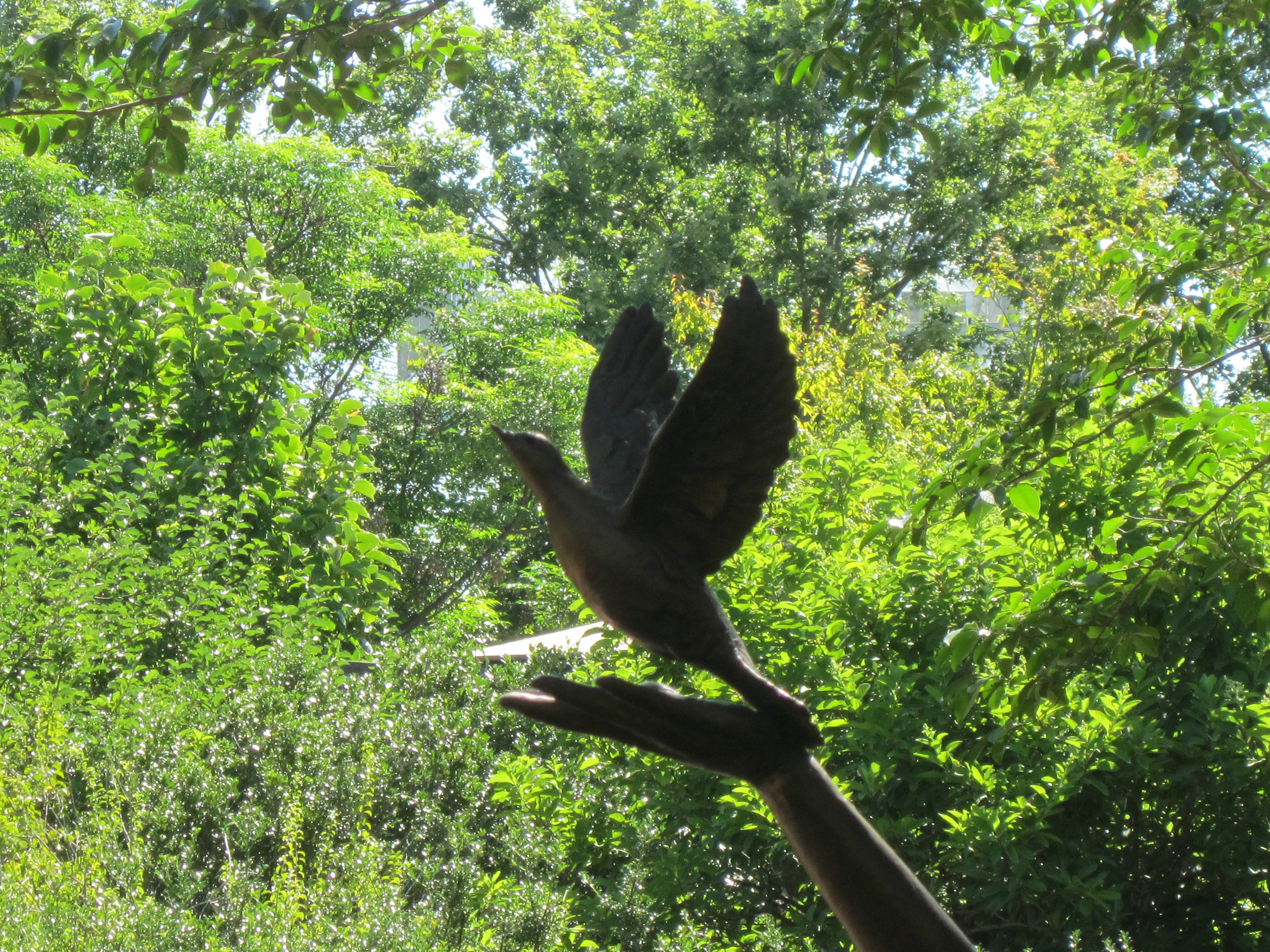
Sitting here now, the image of the open hand with bird came to mind as the words “giving and receiving” arrived in my awareness.

What do you see: giving or receiving?

The first question, “What do you see: giving or receiving?”
I thought of the open hand, the bird’s wings. It seems to be giving, but then I realized on a second glance it could also be receiving. The first glance sees “giving,” and the second glance sees “receiving.” Time seems to make the difference in what I see. The photo may capture one aspect, but the other is there too. What’s important to recognize is the exchange—the dynamic movement. It is both, giving and receiving, the unceasing exchange of energy.

Continue reading

Separating the Wheat of Life from the Chaff — some wisdom from Helen Luke’s essay, “The Odyssey”:
“Why do you speak of a winnowing fan,” said Odysseus, “when you must know very well that this is a beautiful oar with which I cleave the great waters of the wine-dark seas around us?” …

“You are right, I am not ignorant of the oar… I was not pretending by using the words ‘winnowing fan’…I ask you now only to think of the meaning of that image.”
Continue reading “Separating the Wheat of Life from the Chaff”

Receiving the Precious Gift of Time

By Friday night, March 13, all organized activities and classes were cancelled, and I realized the pandemic had cleared my calendar for at least two weeks. Life suddenly became uncrowded as daily routines were swept away.

In the clearing, I saw the precious gift we have received:
the gift of time.

For at least the next two weeks, there is an abundance of unscheduled time. How often does this happen in a lifetime? What discoveries are within reach if one’s focus shifts away from scarcity to recognizing this unexpected opportunity in this present life?

The gift has been given and although I cannot hold it in my hands, I can acknowledge the gift and receive it. Continue reading “Receiving the Precious Gift of Time”

Gifts that Keep Giving

I just cycled back to Phil Constineau’s pilgrimage to Angkor Wat. I bought The Art of Pilgrimage when it was just published in 1998.  Only recently I recognized the deeper connections: Angkor Wat was the center of Phil’s book, and the spark that would light his travelers lamp was a book from Phil’s dad.

This book quietly illuminates the full circuit of a living gift.  It keeps giving and the reach continues to expand.

Discovering the Hidden Beauty of the World

Phil received the book about Angkor Wat on his eleventh birthday.  It wasn’t a gift he had asked for, but the bronze-tinted book depicted sculptures of the long forgotten world of the Khmers that transported the eleven-year old beyond known boundaries. Continue reading “Gifts that Keep Giving”

Recognizing the Vastness That Has the Potential to Transform Us

“The rewards are infinite when we keep looking.”

As soon as I read that sentence by Mark Nepo, I thought of my friend walking the shore of Boneyard Beach immersed in his creative process.

Nepo’s words are in the chapter “Going with the Stream” from his book “Drinking From the River of Light.” The chapter begins with an epigraph by Yogananda:

Never give up, then surrender

Continue reading “Recognizing the Vastness That Has the Potential to Transform Us”

Recognize Creative Tension as a Source of Creative Energy

Once again, I found myself stuck in the foggy gap. I’ve been focused on defining my vision for this second half of life (not a bad thing) but there’s a lot of unknown in this new life. I got fixated on the fog of uncertainty, but today I caught a glimpse of what was in front of me:  the reality of creative tension. Once again, the fog lifts (and I do recognize this is a pattern).

What is creative tension?

I’ve been approaching creative tension as the obstacle, which is a big mistake. It can actually be the force to move me forward. Peter Senge dives into the topic in his book, The Fifth Discipline:

The juxtaposition of vision (what we want) and a clear picture of current reality (where we are relative to what we want) generates what we call “creative tension”: a force to bring them together, caused by the natural tendency of tension to seek resolution.

The gap is the creative tension

Senge continues later in the book: The gap between vision and current reality is also a source of energy. If there was no gap, there would be no need for any action to move toward the vision… Continue reading “Recognize Creative Tension as a Source of Creative Energy”

Blog at WordPress.com.

Up ↑